- About Us
- Our Work
- Resources
- Get Involved
- Blog
- Support Us
By Canopy Team on November 13, 2026
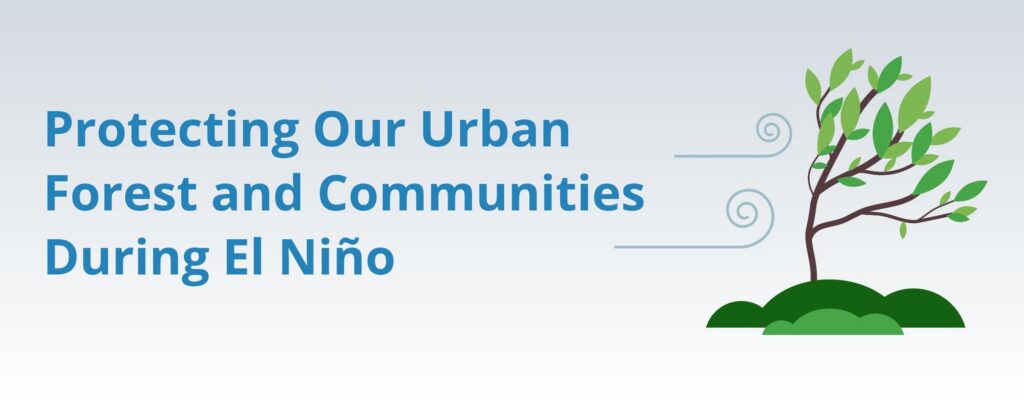
Our urban forests are vital community assets, providing us with generations of invaluable benefits including shade, cooling, clean air, health, and joy. With a projected strong El Niño this winter, it’s essential that trees are a part of your preparation plan. Just like our power grids, utilities, and stormwater systems, trees are critical infrastructure that need the attention of municipalities and residents to keep our trees and communities safe.
Large trees are resilient living organisms capable of withstanding powerful elements and conditions. Flexible branches and extensive root systems anchor trees to the earth and allow them to sway and absorb the force of winds and rains. Healthy trees are often adapted to brave the storms of El Niño.
However, trees with existing conditions such as structural defects, decay, disease, dieback, broken branches, and poor root structure will be more vulnerable to failure from the additional stress of El Niño’s prolonged, strong rains and winds. These trees may appear healthy during fair weather but can pose risks during storms. Saturated soil can also impact tree stability, particularly for trees growing in shallow, compacted, or poorly drained soil.
If you recognize any of these warning signs in your trees, we recommend having them assessed by a qualified, credible arborist to identify and mitigate potential hazards before severe weather starts. Check out Canopy’s arborist list to locate one near you!
Newly planted trees face different risks than mature trees. As they are still establishing, they have not yet grown extensive root systems to anchor them, and their branches and trunks are small and prone to snapping.
The goal should be to preserve our urban canopy, not to remove trees simply because El Niño is approaching. Extreme measures such as topping and excessive pruning are not recommended by arborists, as they can weaken trees and actually make otherwise healthy trees more hazardous.
Be cautious of tree companies that exploit concerns about El Niño to create a sense of urgency or panic and profit from unnecessary tree removals. Search for credible arborists using Canopy’s arborist list that will help reduce risk while preserving healthy trees wherever possible.
For life-threatening and/or serious emergencies, like a tree falling on your house or a downed power line, CALL 911.
Call PG&E at 1-800-743-5000 if a fallen tree or branch hits or tangles with power lines. Always stay at least 35 feet away from downed wires.
For urgent tree-related issues that are non-life threatening, call the non-emergency police line at 650-321-1112.
For downed street trees (or any public tree): call Public Works at 650-496-6974 on weekdays from 7AM – 4PM or 650-329-2413 after hours and on weekends.
For downed public/street trees blocking a street or sidewalk, call the City of Mountain View’s Public Works Department at 650-903-6329 during weekday hours of Mon-Fri 8AM – 4PM or email [email protected]
For fallen trees, blocked storm drains, sinkholes, landslides, call City of Menlo Park Public Works 650-330-6780 from 7:30AM – 4:30PM on weekdays and 650-330-6300 on weekends and after hours.
For fallen trees on County-maintained road, sidewalk, or public right-of-way, call the San Mateo County Department of Public Works at 650-363-4100, available 24/7.