- About Us
- Our Work
- Resources
- Get Involved
- Blog
- Support Us
By Canopy Team on September 23, 2026

Palo Alto, CA – When students at Gunn High School participated in Canopy’s Wellness Walks this summer, they were asked to do something deceptively simple: slow down.
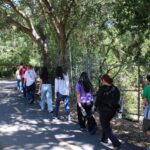
They walked without talking. They practiced breathing exercises. They watched the movement of leaves and birds. They lay in the grass and paid attention to what they could see, hear and feel. And along the way, they learned about the trees they pass every day on their own campus.
Afterward, students described feeling calmer, less stressed and more aware of a natural environment that had been around them all along.
“The walk opened my mind to calmness,” one student wrote. “Not being on the screen in nature is really relaxing. Things I never paid that much attention to suddenly had more value and beauty.”
Now, Canopy is bringing Wellness Walks back — and expanding them.
This fall, Canopy will lead 10 Wellness Walks across Palo Alto Unified School District’s two comprehensive high schools, reaching approximately 284 students. Five walks will take place at Gunn High School on September 28 and 29, reaching 134 students, followed by five walks at Palo Alto High School on October 19, expected to reach approximately 150 students.
The expansion brings an approach first experienced by Gunn students this summer to hundreds more students during the regular school day, giving them practical mindfulness techniques they can continue using long after the organized walk ends.
The idea behind the program is straightforward: the trees surrounding students every day can be more than something they pass between classes. They can become places to pause, breathe and reset.
“We spend a lot of time teaching young people why trees matter to our communities. Wellness Walks invite them to discover why trees can matter to them personally,” said Jean-Paul Renaud, Executive Director of Canopy. “Our hope is that a student facing a stressful exam, a difficult day or simply feeling overwhelmed remembers that there is a tree outside their classroom where they can take a few minutes, breathe and find some peace.”
Canopy’s Wellness Walks combine environmental education with guided mindfulness practices, including silent walking, box breathing, sensory awareness, observation exercises and journaling.
The summer participants’ feedback suggests that something as simple as slowing down changed the way many students experienced their own campus.
One student said the walk “helped me calm down and focus on smaller things,” including “the breeze, birds, and leaves.”
Another wrote: “I didn’t ever take advantage of the trail that Gunn has, so as I walked I realized how beautiful it was and how easy it would be for me to come here and just walk for 20–30 minutes sometimes.”
For some students, the experience provided a noticeable interruption to the pressures and distractions of the school day.
“I was able to notice things that I wouldn’t have noticed and it helped me calm down and slow down,” one student wrote. “A lot of things that I was stressed about weren’t on my mind as much.”
Another said the experience “put me in a better headspace for the rest of the day.”
Across the summer feedback, students repeatedly described the experience as calming, peaceful, relaxing or grounding. They also reported noticing details in nature they normally overlooked and expressed greater curiosity about the trees growing on their own campus.
And when asked how Canopy could improve the experience, a recurring answer was revealing: give us more time. Students asked to walk farther, spend longer observing the trees and have more time for the mindfulness activities.
The Wellness Walks reflect Canopy’s approach to environmental education — teaching young people not only about the ecological benefits of trees, but inviting them to build their own relationships with the natural world.
That connection can begin with something as small as learning the name of a tree.
Students participating in the summer walks used tree guides to identify species around Gunn and learned about their characteristics and history. Several reported that they had walked past those same trees many times without really noticing them.
“I usually don’t analyze the trees when I go on walks,” one student wrote. “It was also a good way to learn the benefits of silence and observation rather than listening to music.”
Another reflected: “I think if I were to do this more often I would be a lot calmer.”
That idea sits at the heart of the program. Students don’t need to travel to a distant forest to experience nature. At their own schools, nature is already part of their everyday environment.
The challenge is learning to notice it.
“Community forestry is ultimately about the relationship between people and the places where they live, learn and gather,” Renaud said. “If a young person learns the name of a tree, finds shade beneath it, takes a breath there during a difficult day and begins to care whether that tree is still there years from now, we have created something much more powerful than a single environmental lesson.”
As Canopy begins its 30th planting season, the expansion of Wellness Walks across Palo Alto’s high schools represents another way of connecting the next generation with the urban forest — helping young people understand that trees contribute not only to healthier and more resilient communities, but also to the everyday places where people can connect, recharge and flourish.
About Canopy
Canopy collaborates with communities to grow and sustain equitable urban forests for all. We envision connected communities thriving within a vibrant urban forest.