- About Us
- Our Work
- Resources
- Get Involved
- Blog
- Support Us
Para consultar la descripción del curso de español, véase más abajo.
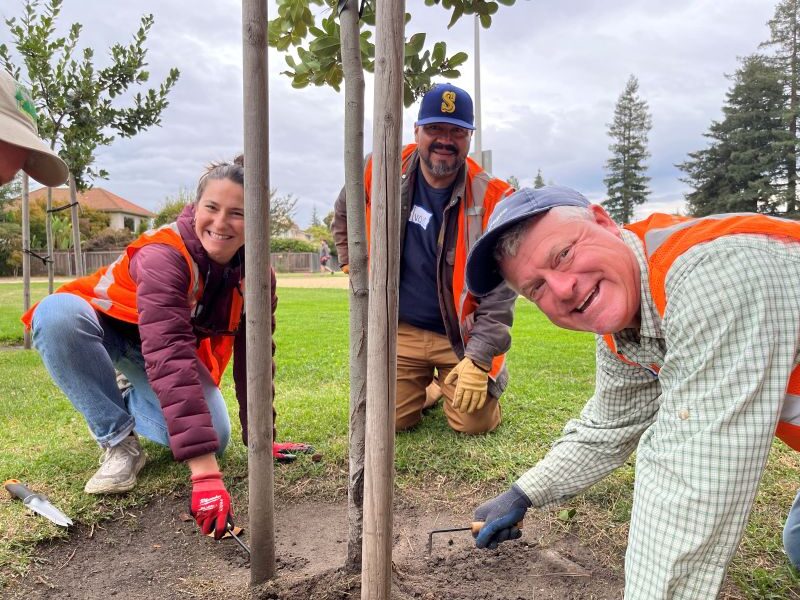
Canopy is offering a FREE UC Climate Stewards certification course in Santa Clara and San Mateo County. The course prepares participants to integrate nature-based climate solutions within their communities through community science projects, environmental stewardship, and climate communication to advance ecosystem resilience in the urban forest.
This 10-week course requires 45 in-class and asynchronous hours, including online workshops, tree planting fieldwork, tree care fieldwork, and 8 hours of environmental stewardship hours on an urban forestry project. The asynchronous work will strengthen participants’ knowledge, self-efficacy, and agency by building climate literacy, introducing local opportunities for nature-based climate mitigation and adaptation solutions, and fostering climate communications skills. Canopy’s UC Climate Stewards Certification Course will focus on urban tree planting and tree care as nature-based climate solutions, integrating climate science communication, environmental justice, and community stewardship.
This course includes certification as a UC Climate Steward upon completion of all course requirements, the opportunity to become a Canopy-Certified Community Forester, and the option to obtain 4 undergraduate credits through UC Davis Continuing and Professional Education.
Este curso gratuito de 10 semanas se centrará en la plantación de árboles urbanos, las comunicaciones sobre el clima, la justicia medioambiental y el cuidado de los árboles como soluciones climáticas basadas en la naturaleza. Los estudiantes participarán en talleres en línea facilitados por arbolistas certificados, plantación de árboles y trabajo de cuidado de árboles, y 8-15 horas de servicio voluntario en un proyecto de gestión forestal urbana.
Online Zoom classes: Thursdays, September 17 through November 19, 2026, from 6:30-8:30 p.m.
Clases en línea por Zoom: los jueves, del 17 de septiembre al 19 de noviembre de 2026, de 6:30 a 8:30 p.m.
Outdoor field experiences / Experiancias al aire libre:
Cost / Costo: FREE / Gratis
Este curso es bilingüe con traducciones en directo del inglés al español.
This is a bilingual course with live translations from English to Spanish.
Applications for the Fall 2026 session are open and due September 7, 2026. Email Canopy’s Community Education Coordinator, Desiree Humphers, at [email protected] with any questions.
Las aplicaciones para la sesión de otoño 2026 están abiertas y vencen el 7 de septiembre de 2026. Envíe un correo electrónico a Desiree Humphers a [email protected] con cualquier pregunta.
This program is in partnership with the University of California and made possible by a generous grant from the County of Santa Clara Board of Supervisors.
To support community forestry efforts and education like Community Forestry School, consider a gift to Canopy. Donate here.

Learn about urban forestry, climate change, and review set up instructions for the course.
Trees are beneficial for public health and they benefit our lives daily. Learn about the benefits of trees, how trees function, and how the biology of trees relates to climate change.
Why don’t we only plant oak trees? Learn about the structure of our urban ecosystem and the considerations needed to plant a tree that will benefit our community. This class also prepares students to conduct a site assessment.
Learn how to determine if a tree is healthy and how to maintain a tree. This class also prepares students to prune young trees to improve their health and increase their chances for a long life.
People and our environments are connected together. The natural world around us can affect our health and what we do can affect the health of our environment. Learn how trees affect our daily lives and public health. This class also prepares students to plant a tree.
Different areas experience different climate challenges. Some areas experience these challenges more than others. Learn what factors contribute to the differences in environments around our area and what can be done to decrease these challenges.
Learn about environmental justice and local urban forest advocacy issues from folks who have been doing this for years and find out how to take action in your community. Spend class time working on your stewardship project with your classmates, catching up on coursework, and/ or asking any questions to your instructor.
Interested in pursuing a career in urban forestry? Looking to learn more about the environment? Join this session to learn about future opportunities! After, spend class time working on your stewardship project with your classmates, catching up on coursework, and/ or asking any questions to your instructor.
Last sessions! Share your 5-minute presentation about your stewardship project with the class. It will take 2 sessions to complete presentations for everyone. The second presentation day will be the last session!
Horario de cursos del otoño de 2026
Aprende sobre la silvicultura urbana y el cambio climático, y revisa las instrucciones de configuración del curso.
Los árboles son beneficiosos para la salud pública y nos aportan beneficios en nuestra vida cotidiana. Descubre los beneficios de los árboles, cómo funcionan y cómo su biología se relaciona con el cambio climático.
¿Por qué no plantamos solo robles? Conoce la estructura de nuestro ecosistema urbano y los aspectos que hay que tener en cuenta para plantar un árbol que beneficie a nuestra comunidad. Esta clase también prepara a los estudiantes para realizar una evaluación del sitio.
Aprende a determinar si un árbol está sano y cómo cuidarlo. Esta clase también prepara a los alumnos para podar árboles jóvenes con el fin de mejorar su salud y aumentar sus posibilidades de tener una vida larga.
Las personas y nuestro entorno están interconectados. El mundo natural que nos rodea puede influir en nuestra salud, y nuestras acciones pueden afectar la salud de nuestro entorno. Descubre cómo los árboles influyen en nuestra vida cotidiana y en la salud pública. Esta clase también prepara a los alumnos para plantar un árbol.
Cada zona enfrenta diferentes retos climáticos. Algunas zonas se ven más afectadas por estos retos que otras. Descubre qué factores contribuyen a las diferencias en los entornos de nuestra zona y qué se puede hacer para mitigar estos retos.
Aprende sobre la justicia ambiental y los temas relacionados con la defensa de los bosques urbanos locales de la mano de personas que llevan años dedicándose a esto, y descubre cómo puedes actuar en tu comunidad. Aprovecha el tiempo de clase para trabajar en tu proyecto de gestión ambiental junto con tus compañeros, ponerte al día con las tareas del curso y/o hacerle preguntas a tu instructor.
¿Te interesa seguir una carrera en silvicultura urbana? ¿Quieres aprender más sobre el medio ambiente? ¡Únete a esta sesión para conocer las oportunidades futuras!
Después, aprovecha el tiempo de clase para trabajar en tu proyecto de administración responsable con tus compañeros, ponerte al día con las tareas del curso y/o hacerle preguntas a tu instructor.
¡Últimas sesiones! Comparte con la clase tu presentación de 5 minutos sobre tu proyecto de gestión responsable. Se necesitarán 2 sesiones para que todos puedan presentar sus proyectos. La segunda jornada de presentaciones será la última sesión.
Testimonials from past Canopy Community Forestry School graduates:
“It was like overnight, I was able to understand the trees around me. Suddenly everything was obvious- why that tree was planted under the power lines, how that tree was pruned, how that tree is mulched, etc. I was immediately connected. Everything I was learning was right in front of me all along.”
“I’ve always loved trees, but I have a much deeper understanding now of why trees are so important to our local communities. I learned about inequities in the distribution of trees in the region, why that matters, and what we can do about it. I have resources now to advocate and care for trees that I didn’t have before, and I intend to continue the learning process and translate what I’ve learned into action.”
From California ReLeaf, a statewide organization that supports California’s urban and community forests through grassroots efforts and strategic partnerships:
“Canopy’s Community Forestry School delivers high-quality training on important urban forest topics from tree planting and maintenance to community advocacy — engaging volunteers to steward and speak for trees in their communities. Their educational programs have been inspiring and helpful to other urban forest community groups — whether just starting out in this work or seasoned nonprofits.” – Cindy Blain, Executive Director of California ReLeaf